The construction industry has evolved beyond traditional materials — it now demands innovation, precision, and environmental accountability. As sustainability becomes integral to modern infrastructure development, the role of responsible packaging in construction chemicals has gained unprecedented importance.
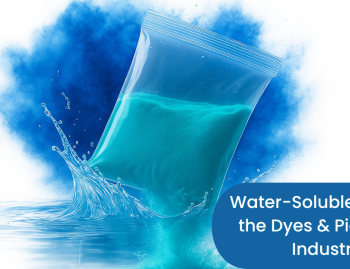
In the dyes and pigments industry, where formulations involve concentrated chemicals and sensitive handling, the adoption of eco-efficient, water-soluble packaging materials offers dual advantages – safeguarding workers and end consumers while advancing sustainability goals. Even incremental moves toward environmentally responsible solutions can deliver measurable improvements in waste reduction, compliance, and overall brand value.
From admixtures to corrosion-inhibitors, construction chemicals & building materials require careful handling, accurate dosing, and safe packaging. In this context, Water-Soluble Films (WSF) have emerged as an efficient, eco-friendly solution that enhances process safety while minimizing waste generation.
Sustainable Packaging and Operational Efficiency
In a sector where precision and performance are non-negotiable, Water-Soluble Films offer both environmental and operational advantages. These biodegradable PVA-based films dissolve in water, presenting a sustainable-oriented alternative to traditional packaging approaches.
For corrosion-inhibitor packaging, Water Soluble Films enable direct dosing — the entire pack dissolves in the solution or concrete mix, releasing the active ingredients safely and efficiently. This approach not only improves worker safety but also eliminates packaging waste, aligning perfectly with the principles of a circular economy.
By replacing conventional plastic sachets or containers with eco-friendly dissolvable films, manufacturers reduce carbon emissions, enhance efficiency, and ensure safer handling during storage and application.
Construction Chemicals: A Growing Industry
The construction chemicals market is expanding rapidly, driven by infrastructure growth, urbanization, and the demand for durable, high-performance materials. Products like admixtures, sealants, waterproofing agents, and corrosion-inhibitors are essential for extending the lifespan of concrete structures.
However, as the industry grows, it faces mounting pressure to reduce its environmental footprint. Chemical leakage, packaging waste, and unsafe disposal practices are emerging as key challenges. Adopting Water-Soluble Film packaging is an effective step toward achieving compliance, safety, and sustainability without compromising product integrity.
Environmental and Safety Challenges
Traditional packaging for construction chemicals — often made from multilayer plastics — can lead to contamination, waste disposal issues, and occupational hazards during manual handling. Exposure to chemical dust or spills also increases health risks at worksites and manufacturing facilities.
By using dissolvable film packaging, these issues are mitigated. The films dissolve completely during use, leaving no residue, dust, or microplastics. This not only protects the workforce but also supports ESG and sustainability goals by lowering material waste and improving resource efficiency.
Advantages of Water-Soluble Films in Construction Chemicals
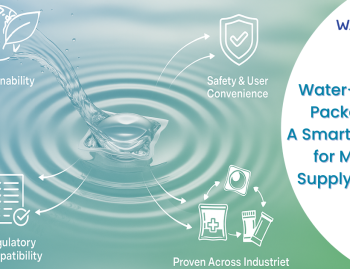
Water-Soluble Films bring both functional and environmental value to construction chemical packaging. Their use in corrosion inhibitor formulations is already demonstrating measurable success in improving safety and convenience across job sites.
Key Benefits:
- Complete dissolution in water-based systems — no waste disposal required.
- Accurate dosing with pre-measured packaging, reducing formulation/application errors.
- Improved worker safety, eliminating direct contact with chemicals & hazardous dust inhalation
- Biodegradable and non-toxic, leaving no harmful residues.
- Reduced logistics and storage costs due to compact and lightweight packaging.
- Enhanced efficiency through zero contamination and simplified handling.
- Supports sustainability goals by reducing plastic waste and environmental impact.
Conclusion
As industries redefine their sustainability goals, Water Soluble Film packaging is transforming how dyes and pigments are handled, stored, and used. It not only promotes eco-friendly practices but also strengthens worker protection and process accuracy through safer, pre-measured dosing systems.
By adopting eco-friendly and dissolvable packaging solutions, the construction chemicals sector can take a decisive step toward zero-waste operations, safer workplaces, and sustainable growth. Water-Soluble Films are not just packaging — they are a part of a smarter, cleaner, and more efficient future for the construction industry.
Water-Soluble Films are more than a packaging innovation – they are a pathway to smarter, safer, and more sustainable chemical manufacturing.